Tuesday, 12 November 2019
Year 8 Orientation
During Term 4, our Year 8 students visited Kaitaia College for an orientation day. Multiple schools were in attendance and it was a very busy and interactive day for everyone. The day started with a powhiri under Te Kapua, which is the schools new sport complex. We were welcomed with karanga, waiata, haka and whaikorero.
The children were put into groups and assigned some student leaders from Kaitaia College to show them around the school and take them to their organised events. We visited 4 workshops during the day: Maths, Science, P.E., and Maori Performing Arts.
I was very proud of the behaviour, enthusiasm and respect of our Year 8 students. They were very engaged in all the activities; they were polite and followed instructions; and they were active participants in every activity they were immersed in. They were all very tired at the end of the day, but they thoroughly enjoyed themselves. It seems that their confidence increased a little about the fact that they will be leaving at the end of the year. I'm really excited to see what each of them do with their futures.

Friday, 26 July 2019
Tuesday, 18 June 2019
Collaboration in Huia Whanau


This week, Huia Whanau are focusing strongly on our school values. Kaingaroa School has five key values: Kia Tika (respect),
Kia Mahara (responsibility),
Kia Pono (equity),
Kia Manawanui (resilience), and
Kia Ngawari (kindness).
Today, our class organised themselves into five groups and assigned themselves one of the key values. They also assigned themselves a pou, which would become their groups responsibility. They delegated responsibility throughout their group according to people's interests and strengths. One person from each group started the process of their pou by sanding it back, and then putting the first layer of paint on. The rest of the group worked collaboratively inside, working on the design features of their pou. They needed to decide on font, size, colour, spatial awareness; providing a draft of both the front and back view.
Huia Whanau are continuing to grow and develop their abilities to work collaboratively, and demonstrate our school values. Next week, groups will begin to transfer their designs onto their pou. Everyone is looking forward to seeing their finished products, that they will then be planting in our values garden.
Saturday, 15 June 2019
Monday, 3 June 2019
Simple science - Bouncy eggs


As part of our learning in literacy, Huia Whanau have been focusing on the anatomy of the human body. We've previously been learning about the skeletal system and the structure of our bones. We did a simple science experiment to help our understanding around the different layers of human bone.
We started by researching the difference between calcium and calcium carbonate. We learnt that calcium is a product that makes the outer layer of our bones strong, and we commonly get it from food sources such dairy products and seeds. We then learnt calcium carbonate is a compound product, meaning it is made up of two ingredients, much like compound word or a compound sentence. Calcium carbonate is 60% calcium and 40% carbonate, which is a chalk-like substance we get from rocks such as limestone.
Calcium carbonate is a product that people take if their diet is lacking in calcium. This helps them to make sure they are getting enough calcium. However, overuse over a long period of time, can cause damage to the kidney - this is because the added carbonate isn't healthy for human consumption.
We learnt that egg shells are similar to human bones, and made from calcium carbonate. Like human bones, the outer layer is strong and designed to protect. Also like the human bone, the inner layer acts as a sponge. We submerged our raw eggs in a glass jar filled with white vinegar. We then left them sitting for 4 days. Over the 4 days, we saw some changes in our eggs as the outer layer was no longer protecting the egg, and the second layer was beginning to soak up the vinegar. Our eggs lost their brownish colour, grew in size, and began to sink to the bottom of the jar.
After the final day, we removed our eggs and took them to the top court to see if they would bounce. Some eggs broke as soon as they were pulled from the jar, while others were successful in bouncing. Those that were successful, however, only bounced a few times before breaking as well.
TEDx FondduLac
The secret to being enough
Nadine Machkovech
I got very emotional listening to two messages tonight: “The secret to being enough” and “The other side of ego”. In “The secret to being enough”, Nadine talks about the feeling most people experience of being unworthy or ‘not enough’. She shares her story growing up and experiencing this way when her parents got a divorce, and being the youngest of five girls, and going to school. She talked about caring too much about what other people thought of her at a young age, and putting her worth in the hands of others, especially boys. She talked about taking drugs to hide the pain she was experiencing on a daily basis, and becoming an addict at the age of 14. She also talked about sitting on the edge of a lake, wanting to end her own suffering.
Nadine talked about reconnecting with her older sister, who loved her and accepted her as she was, but needed her to change. Her sister took her in on the condition that she get sober. Her sister laid out clear rules and expectations and curfew, and Nadine felt like she was being treated like a child. Nadine was 23, and fell to her knees, asking her sister for help.
She is now sober in long-term recovery, living her own truth. She speaks about the shift in her mindset towards her self-worth, and challenges the audience, instead of “Why me?”, o ask themselves, “Why not me?”.
This is the question I choose to challenge myself with. When I'm sitting in my classroom, questioning my ability. When I'm marking their assessments, questioning myself having taught them the best I could. When I'm struggling to manage my emotions in classroom full of emotional pre-teens, I choose to challenge myself with this question.
Why not me? Who am I to play small? Playing small doesn't serve my students, nor does it serve myself. Why not me?
Sunday, 2 June 2019
Statistical Sorts


At the beginning of term 1, Huia Whanau experienced extreme disappointment when they realised they didn't know that much about statistics at all. The class struggled to answer statistical questions at level 2, and were unable to show any perseverance during their pre-assessment.
After finishing their learning at the end of the term, the class were more than competent at organising these sorts and finished well within the time frame given. They challenged the level of their learning by sorting images of statistical displays, the names of statistical displays, and the definitions of said displays. It amazed me at how much of the mathematical learning the entire class seemed to soak up throughout the term. They were very proud of their progress when they could complete such an activity with success.
Monday, 27 May 2019
Multi-model literacy in Huia Whanau

This term, Huia Whanau have been exploring aspects of the human body through our literacy programme. Part of my feedback from Donna last term, was to include multi-model resources for my students to access during their learning. Literacy in week 3, is an example of what multi-model learning looks like in our classroom.
Using my class site to present new and rewindable learning, has been one of the most successful avenues in supporting student agency. Very seldom do I have students asking me what they should be doing, because it is all on our class site ready for them.
In week 3, we were learning about the anatomy of the human heart. What I'm enjoying most about our programme is that students are exposed to and experiencing all aspects of literacy, including reading, writing, viewing, listening, and occasionally speaking. Students are also given options and choice when creating, for example, some students prefer to working independently while others like to collaborate; some like to write in their literacy books while others like to work on their devices; and some students like to create digitally, while others like to work hands-on. Although each student is learning about the human heart, they have the option of how they would like to learn, within the constraints of our daily must dos and can dos. I'm finding this programme to be extremely demanding of the students, because they are forced to think critically across a range of resources, however it has to be the most successful literacy programme I've run to date.
Junior Tabloids Day
WALT show our leadership skills by teaching junior students physical activities
On Tuesday, Huia Whanau lead a number of different physical activities for over 130 Year 1 & 2 students on the East Coast. We had students come from Peria, Oruaiti, Mangonui and of course, Kaingaroa. Three Huia Whanau students lead an activity as the groups rotated around each station. Games included: rob the nest, lions and antelopes, gecko tails, stuck in the mud, blob tag, builders and bulldozers, and an obstacle course. Afterwards, we had very tired juniors and leaders! It was a fantastic day!


This morning, Piwakawaka Whanau, who are our Kaingaroa Year 1 & 2 class, came to visit us in our classroom. They shared with us their amazing art work and writing around their experiences at our Tabloids Day. Our Piwakawaka students were very grateful for our leadership, patience and of course, the repertoire of physical activities that they can now take away and use in their own class!
On Tuesday, Huia Whanau lead a number of different physical activities for over 130 Year 1 & 2 students on the East Coast. We had students come from Peria, Oruaiti, Mangonui and of course, Kaingaroa. Three Huia Whanau students lead an activity as the groups rotated around each station. Games included: rob the nest, lions and antelopes, gecko tails, stuck in the mud, blob tag, builders and bulldozers, and an obstacle course. Afterwards, we had very tired juniors and leaders! It was a fantastic day!


This morning, Piwakawaka Whanau, who are our Kaingaroa Year 1 & 2 class, came to visit us in our classroom. They shared with us their amazing art work and writing around their experiences at our Tabloids Day. Our Piwakawaka students were very grateful for our leadership, patience and of course, the repertoire of physical activities that they can now take away and use in their own class!
Waitangi Treaty Grounds Visit
WALT understand the Treaty of Waitangi in further detail
On Friday, Huia Whanau visited the Waitangi Treaty Grounds in Paihia, Bay of Islands. We visited the museum and talked about the Treaty and some of the historical events surrounding the signing of the treaty. We explored the grounds and learned about the waka that reside there; we also saw some native birds such as the Kereru, on our hikoi. We had a tutu with some digital technologies including virtual reality, green screen, stop motion, and robots. We had such a good day! We're looking forward to our second visit next week.
On Friday, Huia Whanau visited the Waitangi Treaty Grounds in Paihia, Bay of Islands. We visited the museum and talked about the Treaty and some of the historical events surrounding the signing of the treaty. We explored the grounds and learned about the waka that reside there; we also saw some native birds such as the Kereru, on our hikoi. We had a tutu with some digital technologies including virtual reality, green screen, stop motion, and robots. We had such a good day! We're looking forward to our second visit next week.
Team Building


Huia Whanau spent some time baking on Friday to celebrate the Treaty of Waitangi as well as the signing of their own class treaty. They worked together in teams and focused on team building and communication. They also made some delicious goodies that they all shared; some made cupcakes, while others made brownie and tapioca. They thoroughly enjoyed themselves & started to articulate the team building strategies that they used, their improvements and next steps.
Huia Whanau's Class Treaty

Huia Whanau have been learning and discussing the Treaty of Waitangi and it's significance. We discussed the importance and relevance of the Treaty and how it relates to us. We also looked around our class and discussed how we are all going to be successful this year, talking about thing such as:
- our individual values, why we have them and why they're important to us
- how we learn best, whether it be visual, written, kinaesthetic, etc
- what we need from each other (our classmates) in order for us to be successful
- what we need from our teacher in order for us to be successful
We then highlighted the common themes that were coming through and decided on 4 key points that we then used to create our own class treaty. Here is what we came up with.
Team Building


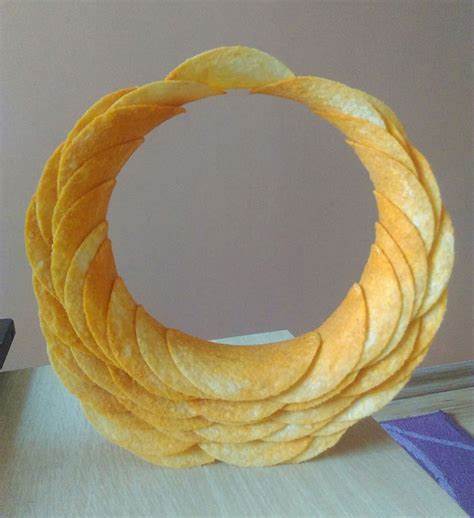
We found today's team building challenge quite difficult. We were given an image of pringles that formed a ring or circle, similar to the one below. We then had time to discuss strategy with our team and think about how we would be successful. After being given a box of pringles per group, we attempted to recreate the masterpiece. Some of our groups worked a lot better together than they did the day before, while others struggle to communicate. It was exciting and thrilling activity, but also very difficult. After some time, we competed to create specific words using our pringles, such as 'Huia', 'Team', and 'Waka'. We were all very happy to eat the pringles at the end.
Team Building


Today Huia Whanau worked on team building strategies in their desk groups. We worked on our communication skills & ability to work together towards the same goal. We did well to practice team work, our next goal is to articulate our strategies.
Team Building


We are focusing on our communication skills and working collaboratively in Huia Whanau. Today our goal was to create a cup tower without using our hands. We used rubber bands and string to move the cups from the ground onto the tower. We had to work together and talk among ourselves to make sure we were all pulling the string at the same time and placing the cup in the right place.
Saturday, 16 March 2019
Walk through, Term 1
Kathy, our principal, observed me teaching literacy last week. A typical literacy lesson starts with a five minute quick write where I set the timer on the TV for all the students to see, and the class writes for five minutes about anything of their choice. We then transition into a read-to, our book this term bring Refugee by Alan Gratz. After which, we move into the lesson for the day.
This lesson was focused on sentence structure as it was highlighted as a whole-class need from our recent assessment. During the lesson, Kathy spoke to two of my students and gathered some student voice. This was incredible. Both students were year 8's, one male and one female.
The first student Kathy spoke to, told her that we are learning about compound sentences and then complex sentences because it's something the whole class needs to improve on. Kathy then asked him what his learning goals were. He asks me where my keys are, grabs them off my desk and moves to corner of the room to unlock the cabinet. He pulls out the box that contains each students academic folders. He selects his folder and sits back down next to Kathy. He opens his folder to his recent writing assessment and proceeds to explain to Kathy that his goals are ideas and structure & language. He tells her that he needs to be working at level four for a year 8, but he's not quite there yet. He tells her that he needs to improve in these two areas in particular, to be working at his expected level. The same thing happens when Kathy speaks to the female year 8.
Kathy writes that there is a clear learning focus in our class. She writes that the students are data literate and can explain where they are currently working and where they need to be. She writes that they are able to articulate their learning goals and identify where they need to improve.
Friday, 1 February 2019
School Vision


All learners are different, whether students or staff. Starting 2019 with a TOD where I helped staff learn, create & share our school vision:
"Whakatupu ana i te huarahi pai mo naianei me apoapo"
"Growing success together: today for tomorrow"
Subscribe to:
Posts (Atom)